A pull-up is a simple but challenging upper-body exercise. You hang from a secure bar with your palms facing away from you, pull yourself up until your chin clears the bar, then lower yourself under control. It sounds straightforward, but good technique makes all the difference.
What muscles do pull-ups work?
Pull-ups primarily work the muscles of your upper back, especially the latissimus dorsi, with help from your biceps, forearms, shoulders and core. Because you’re lifting your own body weight, even a few good repetitions can be quite demanding.
How to perform a pull-up with correct form
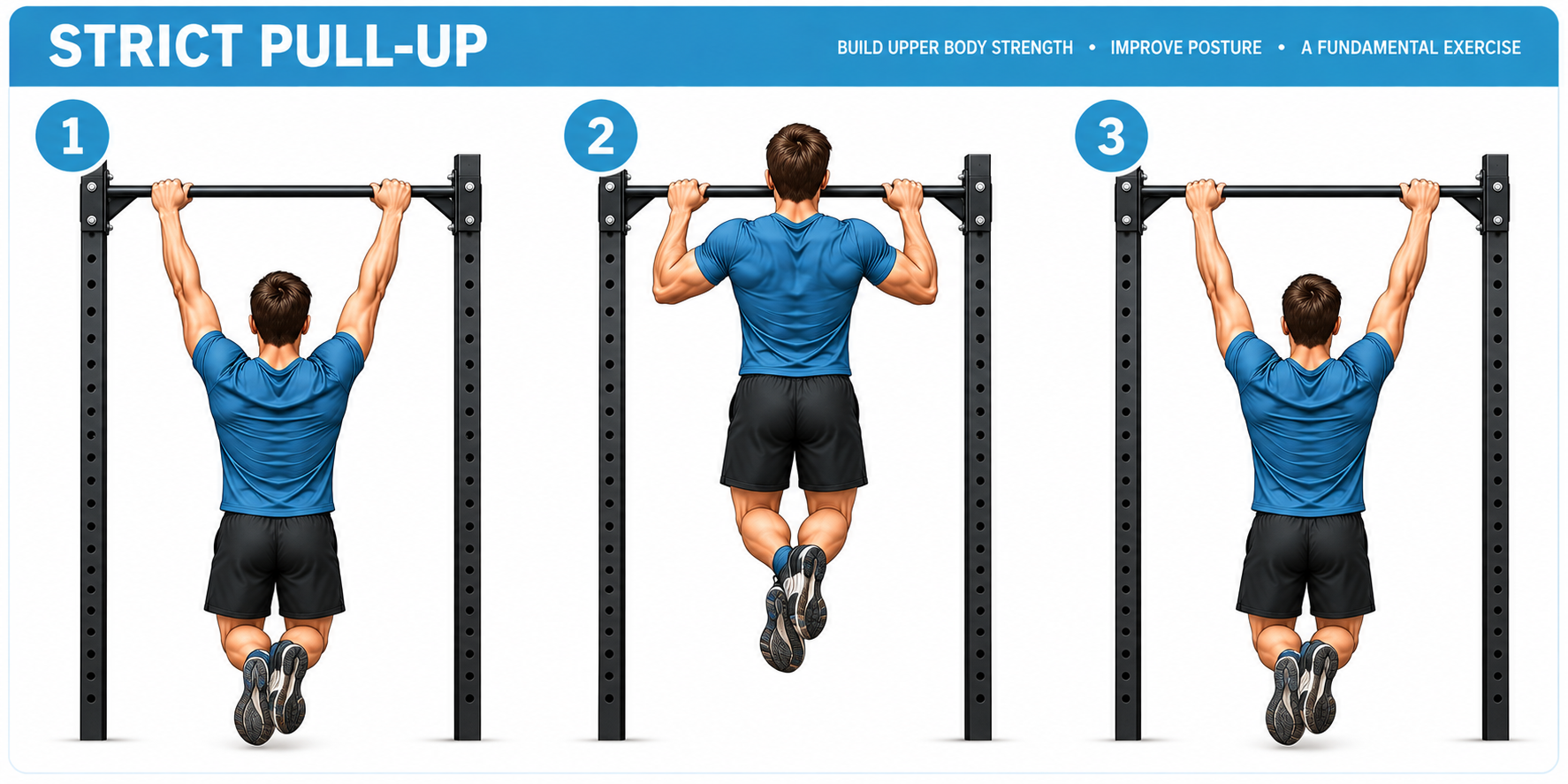
Step 1 — Starting position
Take a comfortable overhand grip on a secure pull-up bar, roughly shoulder-width apart. Start with straight arms, comfortably engaged shoulders and a steady body.
Step 2 — Pull up
Pull your elbows down toward your sides until your chin clears the bar. Keep your core engaged and avoid kicking or swinging.
Step 3 — Controlled lowering
Lower yourself smoothly to the starting position without dropping. Count only repetitions completed with consistent, controlled form.
- Warm up for 5–10 minutes with easy movement and a few lighter pulling exercises.
- Hold a secure pull-up bar with an overhand grip, hands around shoulder-width apart or slightly wider. Use a comfortable grip that doesn’t cause pain.
- Begin with your arms straight and shoulders comfortably engaged, rather than shrugging forcefully toward your ears. Keep your legs quiet and your body steady.
- Pull your elbows down toward your sides, bringing your chin above the bar without reaching your neck forward.
- Lower yourself smoothly to a controlled, comfortable straight-arm position. Avoid dropping suddenly into the bottom.
- Repeat only while you can maintain the same good form. Breathe naturally; avoid holding your breath throughout the set.
Common pull-up mistakes
- Swinging or kicking to get over the bar. For this program, count only strict repetitions.
- Stopping halfway down to squeeze out more repetitions. Use a consistent, controlled range of motion.
- Craning your neck to get your chin over the bar instead of lifting your body.
- Using a grip that’s too wide or pushing through shoulder or elbow pain.
- Going to failure on every set rather than leaving a little strength in reserve.
Pull-up or chin-up — what’s the difference?
A pull-up normally uses an overhand grip, with palms facing away. A chin-up uses an underhand grip, with palms facing you. Both are useful exercises, but the 25 Pullups program uses strict overhand pull-ups for testing and tracking progress.
What if you can’t do one yet?
That’s perfectly fine! Start with an assisted pull-up machine, a securely fitted resistance band or feet-supported pulling exercises. The aim is to practise a controlled movement and gradually use less assistance as you become stronger. See our assisted pull-up guide for beginner-friendly instructions.
Ready to start?
When you’re comfortable with the technique, take the Initial Pull-up Test to find your starting level. Train on three nonconsecutive days per week, and remember that reaching 25 consecutive pull-ups may take longer than six weeks. Good form comes first.